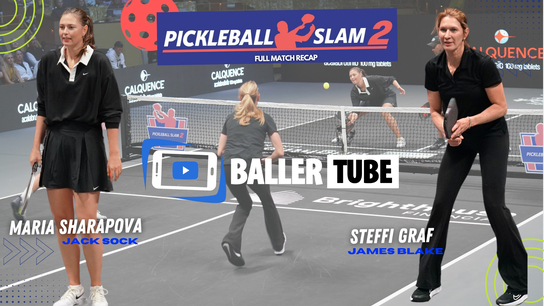



Pickleball Fundamentals Video
20K Views · 4 years ago

 Comments
 Share
Share
 Athletes

 Description
 Albums
 Tags
Tags
 Report Video
3:51
Duration
20K
Views
4 years ago
Submitted
Court Dimensions: Pickleball is played on a rectangular court that is 20 feet wide and 44 feet long for both singles and doubles play. The court is divided into left and right service courts by a centerline.
Net: The net is positioned at the center of the court and is 36 inches high at the sidelines and 34 inches high at the center.
Paddle: Players use solid paddles made of wood or composite materials. The paddles must not have any perforations, and the hitting surface should be smooth.
Ball: Pickleball is played with a plastic ball that has 40 round holes. The ball's diameter should be between 2.87 and 2.97 inches, and it should weigh between 0.78 and 0.935 ounces.
Gameplay:
Serving: The game begins with an underhand serve, diagonally cross-court. The server must keep one foot behind the baseline and hit the ball below the waist.
Double Bounce Rule: The serving team must allow the return of serve to bounce before hitting it, and the receiving team must also let the serve bounce before returning. After the two bounces, both teams can hit the ball before it bounces.
Volleys: A volley occurs when a player hits the ball in the air without letting it bounce. Volleys must be made from behind the non-volley zone, which is a 7-foot area on either side of the net.
Faults: Faults include not clearing the net, hitting the ball out of bounds, stepping into the non-volley zone and volleying, and not following the correct serving sequence.
Scoring: Only the serving team can score points. Games are typically played to 11 points, and a team must win by at least two points.
Rotation: In doubles play, each player gets a chance to serve, and the server switches sides after each point scored.
Non-Volley Zone (Kitchen):
The non-volley zone, also known as the kitchen, is a 7-foot area on both sides of the net.
Players are not allowed to volley the ball while standing inside the non-volley zone, except when the ball bounces in this area.
These are the fundamental rules of pickleball, but there are additional nuances and regulations. It's recommended to review the official rules and engage in practice games to become familiar with the gameplay.
Net: The net is positioned at the center of the court and is 36 inches high at the sidelines and 34 inches high at the center.
Paddle: Players use solid paddles made of wood or composite materials. The paddles must not have any perforations, and the hitting surface should be smooth.
Ball: Pickleball is played with a plastic ball that has 40 round holes. The ball's diameter should be between 2.87 and 2.97 inches, and it should weigh between 0.78 and 0.935 ounces.
Gameplay:
Serving: The game begins with an underhand serve, diagonally cross-court. The server must keep one foot behind the baseline and hit the ball below the waist.
Double Bounce Rule: The serving team must allow the return of serve to bounce before hitting it, and the receiving team must also let the serve bounce before returning. After the two bounces, both teams can hit the ball before it bounces.
Volleys: A volley occurs when a player hits the ball in the air without letting it bounce. Volleys must be made from behind the non-volley zone, which is a 7-foot area on either side of the net.
Faults: Faults include not clearing the net, hitting the ball out of bounds, stepping into the non-volley zone and volleying, and not following the correct serving sequence.
Scoring: Only the serving team can score points. Games are typically played to 11 points, and a team must win by at least two points.
Rotation: In doubles play, each player gets a chance to serve, and the server switches sides after each point scored.
Non-Volley Zone (Kitchen):
The non-volley zone, also known as the kitchen, is a 7-foot area on both sides of the net.
Players are not allowed to volley the ball while standing inside the non-volley zone, except when the ball bounces in this area.
These are the fundamental rules of pickleball, but there are additional nuances and regulations. It's recommended to review the official rules and engage in practice games to become familiar with the gameplay.